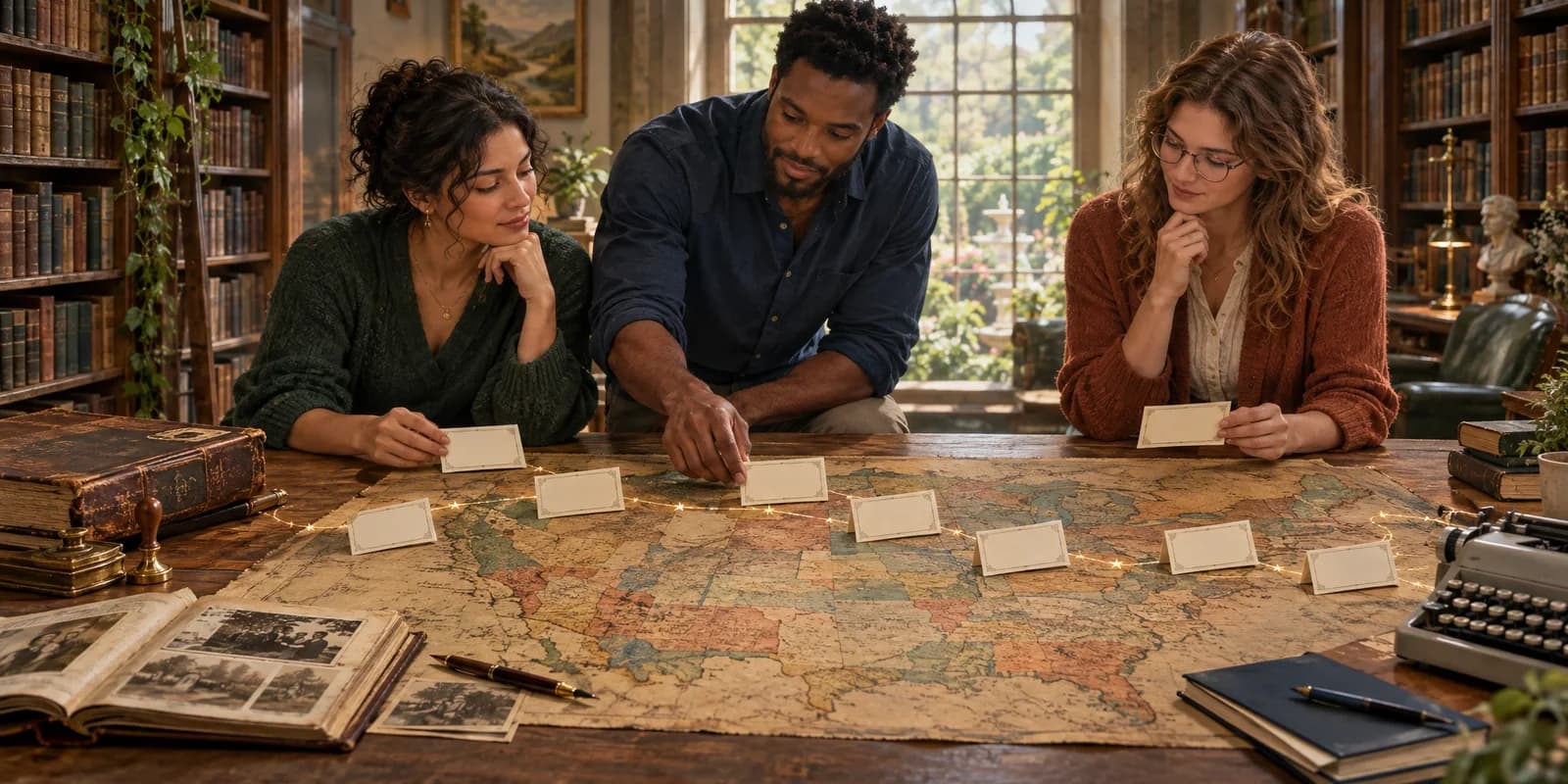
Name a town that feels inhabited, not randomly assembled.
A useful town name generator connects a place to its region, landscape, local economy, era, and everyday character. This tool creates an inspectable shortlist for realistic small towns, villages, fantasy settlements, Western outposts, coastal communities, and other fictional places.
How to use the Town Name Generator
Begin with Settlement type. A village, market town, port, mining community, frontier outpost, and resort town each implies a different reason for existing. Then choose a Setting style and Regional direction. These controls separate the story genre from the sound direction, so an American small town can feel contemporary, while a fantasy market town can still use a restrained British- or German-inspired rhythm.
Geography and economy make the result concrete. A town beside a river should not read like a desert rail stop, and a fishing port should not receive the same local history as a timber town. The Era field controls whether the place feels contemporary, late-1800s, early-1900s, mid-century, medieval-inspired, or timelessly fictional.
Choose one or two tones, then request 10, 20, or 30 names. Open Options to add themes, sound texture, length, opening letters, a founder or source word, a visual idea, or patterns to avoid. Additional details can hold a road, river, neighborhood, local industry, landmark, family story, rivalry, or piece of folklore.
The three presets are editable starting briefs:
- American small town emphasizes plausible everyday life and a memorable Main Street.
- Fantasy market town creates an original, system-neutral settlement for fiction or tabletop play.
- Coastal town ties the name to harbor work, weather, and local routines.
The server requires the exact selected quantity and complete structured records. It checks fixed choices, opening letters, excluded patterns, and duplicate names before displaying the shortlist.
Realistic, modern, and small-town names
For a realistic town name generator task, start with Small town, Realistic modern, and Original invented. Pick a geography and economy only when they matter to the setting. A contemporary farming town on inland plains needs a different history and visual identity from a tourism town beside a lake.
Use American small town when the place should sound plausible in an American story. Pair it with American English-inspired, Canadian-inspired, Pacific Northwest-inspired, or Cajun / Louisiana-inspired only when that regional cue belongs in the brief. These are creative directions, not proof that a generated place follows every real naming convention.
Use British town with British English-inspired for an English town name generator or UK town name generator task. Add a market, river crossing, railway, old estate, coast, or local trade rather than relying only on familiar suffixes. Avoid treating every British-inspired place as medieval or picturesque; modern towns also grow around transport, industry, schools, tourism, and suburban life.
If you want a random town name generator workflow, keep the broad defaults and generate ten names. Compare pronunciation and description first, then open the strongest candidates to inspect their landmark, local economy, resident name, and history hook.
Fantasy, medieval, D&D, and 5e town names
Choose High fantasy for a broad mythical world, Medieval fantasy for an older agrarian or fortified context, and Tabletop fantasy for a campaign-ready settlement. The tabletop choice supports D&D town name generator and 5e town name generator intent, but it is system-neutral. It does not use official Dungeons & Dragons settings, sourcebooks, factions, languages, adventures, or canon town names.
A fantasy town works better when its economy is visible. A crafts town might be known for dyed cloth, glass, bells, or carved wood. A mining town can depend on salt, iron, gemstones, or a dangerous abandoned shaft. A market town needs the road, river, seasonal fair, pilgrimage, or border that brings people together.
For a village name generator task, choose Village and keep the landmark intimate: a bridge, green, mill, shrine, orchard, inn, or watch hill. For a medieval town name generator task, add a founder, trade, defensive feature, or old legal privilege. Those details produce stronger names than simply asking for something ancient.
Western, Wild West, coastal, and port towns
For a Western town name generator or Wild West town name generator task, choose Frontier town, Old West / Western, and Late 1800s. Then identify what brought people there: mining, rail transport, farming, trade, or a river crossing. Rugged sound can help, but a town should not become a pile of gunslinger clichés. The history hook and landmark should explain how ordinary residents live there.
For a coastal town name generator, choose Coastal town or Port town, then Coast / harbor and Fishing, Trade / market, Tourism, or Crafts. Add weather, harbor shape, a lighthouse, cannery, ferry, boatyard, sea wall, or summer population when relevant.
An island town can be coastal without being a major port. A port town can be industrial, historic, prosperous, declining, or remote. The form separates geography from economy so these differences stay visible.
Game-inspired town names without copying a franchise
Searches sometimes ask for an Animal Crossing town name generator, Minecraft town name generator, Pokemon town name generator, or names connected to another game. This tool answers the underlying creative need without creating official or canon-compatible material.
- Cozy game-inspired original favors friendly, compact, memorable places suited to relaxed social worlds.
- Block-building game-inspired original favors readable settlement names that can label a player-built village, harbor, mountain base, or shared server town.
- Tabletop fantasy supports broad campaign use without official rules or setting content.
Do not use generated names as claims of affiliation. The prompt excludes protected characters, locations, items, creatures, terminology, lore, and franchise naming systems.
Regional directions and cultural care
The regional field influences sound and broad construction. It is not a language database or cultural authority. French-, German-, Spanish-, Portuguese-, Irish-, Nordic-, Russian-, Japanese-, Canadian-, Pacific Northwest-, and Cajun-inspired choices remain fictional suggestions.
Each detail view includes a Regional direction note. Read it as an explanation of the creative approach, not an etymology certificate. A proposed local-script form, when present, still needs review by a knowledgeable speaker. For work representing a real community or historical period, verify spelling, pronunciation, associations, and naming conventions independently.
Compare the generated town details
Every card shows the name, pronunciation, settlement type, economy, setting, regional direction, geography, era, tone, and a short description. You can copy the name, hear it through browser speech synthesis, save it locally, or open the complete record.
The detail dialog includes:
- root, settlement element, and qualifier;
- regional, meaning, and construction notes;
- geography and economy fit;
- a concrete history hook and signature landmark;
- a proposed name for residents;
- setting and era fit;
- related local or historical variants;
- independent verification advice;
- Brief fit, Atmosphere, Readability, and Story potential scores.
Scores are AI estimates for comparing the current list. They do not prove authenticity, originality, real-world availability, popularity, franchise compatibility, or legal clearance.
Favorites remain in local browser storage. Use the favorites view to compare a shortlist, copy the visible names, regenerate with the last submitted brief, or use the Town name wheel for a playful final choice.
How this differs from other town generators
Fantasy Name Generators is useful for quickly producing repeated random lists. donjon's Fantasy Town Generator combines settlement controls with a generated map. Reedsy's location generator offers contextual AI-assisted place ideas for writers.
Name Idea Box focuses on the naming brief and shortlist decision. It separates settlement type, setting style, regional direction, geography, economy, and era, then returns name construction, resident identity, landmark, history, geography fit, and economy fit for every candidate. It also validates exact counts, fixed choices, exclusions, and duplicates.
The tool does not generate maps, check live geographic registries, search trademarks or domains, verify native-language usage, or guarantee that a name is unused.
Fix weak or repetitive town names
If the names feel generic, add one reason the town exists and one feature residents see every day. “A coastal town” is broad. “A foggy fishing town around a sheltered harbor and an abandoned cannery” gives the name and history something to carry.
If results feel overdesigned, choose Balanced and familiar or Compact and practical, shorten the length, and remove extra tones. If they feel too plain, add a founder word, folklore theme, landmark, or historic change.
Avoid combining a strict three-letter start, short length, many excluded sounds, a narrow regional direction, and several required concepts unless every constraint matters. A request can become too narrow to support ten genuinely distinct names.
Before publishing a town name:
- Search the exact name and close variants for real and fictional places.
- Check pronunciation, meaning, and unintended associations in relevant languages.
- Test the name on a map, road sign, mailing address, conversation, and local newspaper headline.
- Compare it with nearby settlements so the region has a coherent naming logic.
- Review franchise, domain, trademark, and publication collisions when the project is public or commercial.
Common questions
Is this an official D&D, Animal Crossing, Minecraft, or Pokemon generator?
No. Those searches are handled as broad creative intents only. Results are original suggestions and do not use official settings, characters, terms, rules, items, creatures, or canon naming systems.
Are the regional names authentic translations?
No. Regional choices shape fictional sound and place-name construction. They need independent cultural and linguistic review before representing a real community.
Why did generation fail instead of showing fewer names?
The tool requires the selected count and complete fields. A response that misses fixed choices, repeats names, violates a prefix or exclusion, or omits details is rejected. Retry or loosen the least important constraint.
Are saved towns permanent?
Favorites remain in this browser until its site data is cleared. They do not sync to an account or another device.