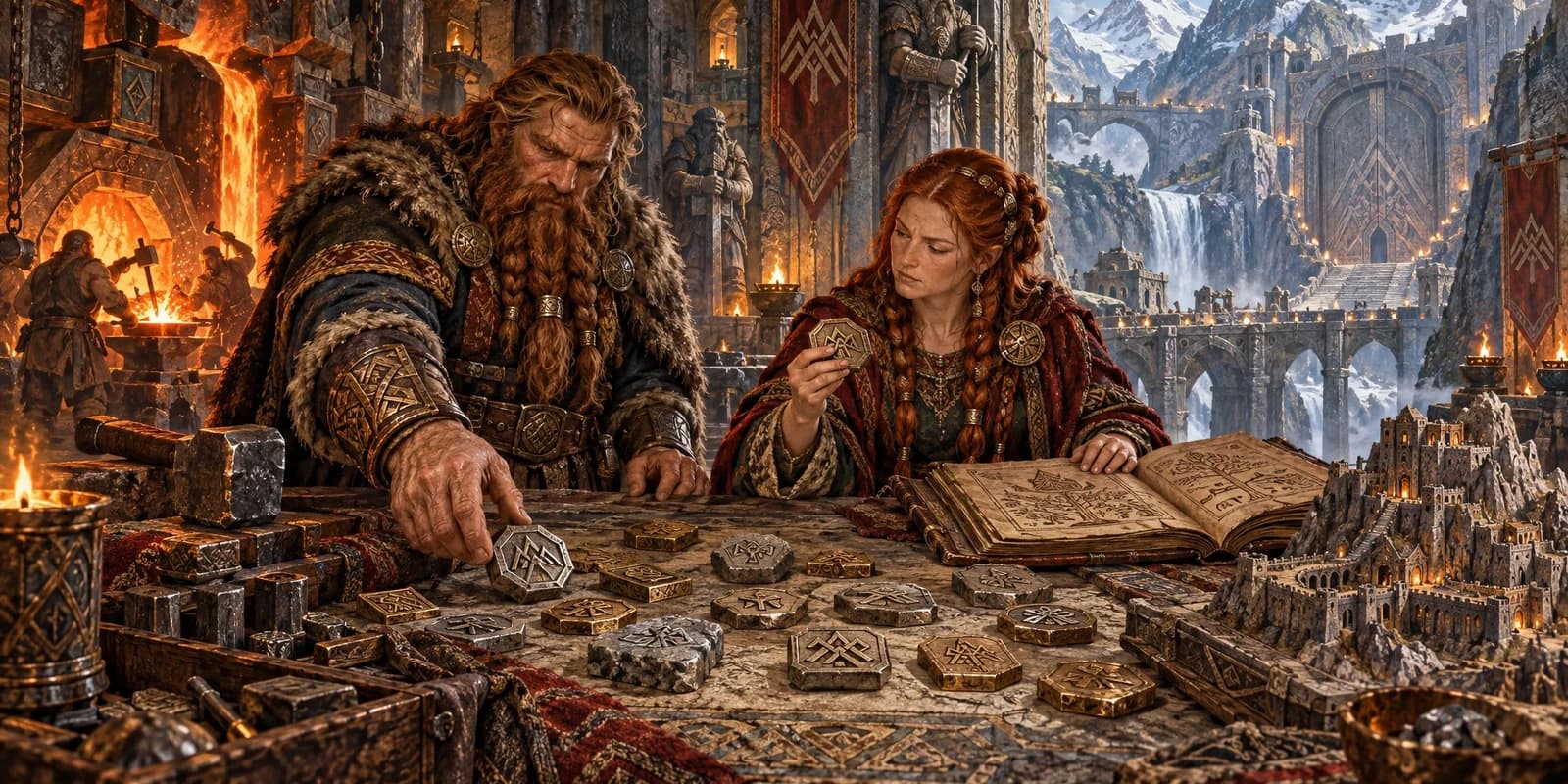
Build a Norse-inspired name without confusing history, myth, and fantasy.
A Norse name generator should do more than return rugged-looking words. This page separates people, bynames, clans, original mythic beings, Jotnar, settlements, dynasties, lands, and worlds, then explains how each result was built and whether its meaning is historical, linguistic, creative, or invented.
How to use the Norse Name Generator for characters and worlds
Start with What are you naming? A personal name, byname, giant, village, and kingdom need different structures, so the generator treats them as separate targets rather than applying one word list to every task.
Choose Full personal name when a character needs a given or core name plus a byname, patronymic-style element, family element, or descriptor. Choose Given name when you need only the personal element. Byname or patronymic is the closest option for a modern search such as “Norse last name generator,” while Clan or family name creates a reusable group identity.
The mythic and worldbuilding targets are equally specific:
- God or mythic being creates an original deity-style figure, not an existing Norse god.
- Jotunn or giant creates an original giant identity and possible epithet.
- Town or city and Village create settlement identities.
- Kingdom or dynasty distinguishes a political realm or ruling line from an ordinary place.
- Land or region and World support larger settings.
Next, choose a History or story direction. Historical-inspired Old Norse, Viking Age-inspired, and Medieval Norse-inspired encourage restrained results but do not certify historical forms. Saga and mythology-inspired emphasizes reputation, natural forces, kinship, conflict, and titles. Original Norse fantasy, Tabletop fantasy, and Nordic game fantasy allow more invention while remaining setting-neutral.
Use only the styles that materially affect the brief. For example, Saga-like plus Seafaring gives a clearer direction than selecting every style. Open Options for meaning themes, rune treatment, sound, length, opening letters, and sounds to avoid. Additional details is where a role, landscape, family relationship, mythic force, settlement economy, campaign function, or taboo can make the results less generic.
The three preset chips are editable starting points for an Old Norse-inspired character, an original mythic Jotunn, or a northern realm. They add text to Additional details; they do not lock the other fields.
Old Norse names with meanings: read the confidence label first
A search for an Old Norse name generator with meaning can hide several different expectations. One visitor wants a documented historical association. Another wants a name that merely evokes sea, winter, ravens, fate, or courage. Treating both as exact translation would be misleading.
Every result therefore includes a Meaning confidence label:
| Label | How to read it |
|---|---|
| Historical association | A cautious, broadly documented association may be relevant, but the generated full result is not automatically attested. |
| Broad linguistic association | A sound or element has a general language connection, without claiming an exact dictionary derivation. |
| Creative association | The name was shaped to evoke the selected image or role. |
| Fantasy invention | The construction is primarily original-world material. |
The National Museum of Denmark’s overview of Viking names explains that name evidence comes from sources including runic inscriptions and place names, and that later writers may have been imaginative about some famous bynames. That is why this page shows a meaning boundary instead of presenting every generated explanation as an etymology.
In a verified local request, the form asked for a female full personal name beginning with S, using Historical-inspired Old Norse, Saga-like and Seafaring styles, Sea and Wisdom themes, and a subtle connection to Wayne. The API returned ten complete results. The first was Svanhild Havröðr, marked Creative association. Its details described a harbor law-speaker and navigator and explicitly called the result a creative modern construction rather than an attested Old Norse name.
That example verifies the implemented response structure and constraints. It does not verify the name as historically used. For publication, teaching, reenactment, tattooing, or other contexts where accuracy matters, check the individual elements against specialist linguistic and historical sources.
Male and female Norse name generator choices
Select Female, Male, or Gender-neutral for people, god-style figures, and Jotnar. Any lets the shortlist vary those directions. The profile changes presentation, but it should not replace a useful character brief.
For a Norse name generator male request, add the person’s function instead of relying on “male” alone: a winter-route merchant, oath-bound guard, exiled skald, or young shipbuilder each needs a different identity. The same principle applies to a Norse name generator female request: a law-speaker, healer, navigator, rival ruler, and saga protagonist should not receive interchangeable names with a different label.
Profile does not apply to clans or places. The server automatically changes it to Not applicable for family groups, settlements, kingdoms, dynasties, lands, and worlds. This prevents a village or realm from inheriting a character-gender field simply because the form has one shared configuration.
Open View details to compare pronunciation, entity kind, name parts, meaning confidence, story role, historical caution, and sound. A result that fits the selected profile but fails the role or spoken rhythm is not yet a strong choice.
Norse last names, bynames, patronymics, clans, and dynasties
“Last name” is useful modern search language, but it can refer to several different creative needs. Use the form to keep them separate:
| Need | Form target | Result detail to inspect |
|---|---|---|
| A second element for one person | Byname or patronymic | Byname or patronymic, historical context, construction note |
| A complete identity | Full personal name | Given/core element plus the second element |
| A shared kin group | Clan or family name | Clan element, story role, related forms |
| A ruling line or realm | Kingdom or dynasty | Dynasty/place element, political role, world fit |
The museum source above notes that bynames could relate to kinship, origin, a quality, or a possession. The generator uses that as a broad editorial boundary, not as permission to call every invented suffix historically valid. A result may use a patronymic-style or descriptive pattern while still carrying Creative association or Fantasy invention.
For a useful Norse clan name generator brief, describe what holds the group together: a harbor, oath, trade route, founder, craft, feud, or landscape. For a Norse dynasty name generator, add the territory, political claim, succession problem, or symbol that makes the ruling line matter. Use the Last Name Generator when the task is a modern or cross-cultural surname rather than a specifically Norse-inspired identity.
Norse god names, mythology figures, and Jotunn giant names
The God or mythic being and Jotunn or giant targets are for original fiction. They do not return Odin, Thor, Loki, Freyja, known Jotnar, or disguised spellings of surviving mythological figures. The output also avoids claiming that a new identity belongs to historical Norse belief.
To use the page as a Norse god name generator, describe the being’s domain, responsibility, contradiction, worshippers, and story conflict. “A keeper of winter promises who protects travelers but punishes broken hospitality” gives the model more structure than “make a cool god.” The details dialog then explains the mythology atmosphere and the boundary between inspiration and surviving myth.
For a Jotunn giants Norse mythology name generator task, choose Jotunn or giant, then add a natural force, territory, bargain, feud, or title. In a verified API request, the brief asked for a male frost giant guarding a broken mountain pass, with Ice and Fate themes, Saga and mythology-inspired direction, and a Younger Futhark-inspired display. The first result was Kragis Frostward, with the entity kind fixed to Jotunn or giant, a title element, mythology context, and the meaning label Creative association.
That result is an original fantasy figure. It is not a name recovered from an Edda, saga, inscription, or academic corpus.
Norse town, city, village, kingdom, land, and world names
Choose the scale before writing the setting brief. A Norse town name generator or Norse city name generator request should explain the settlement’s reason for existing: a fjord harbor, assembly place, winter road, river crossing, timber market, fortified ridge, or sacred landscape. A Norse village name generator brief can be smaller and more local, such as a fishing inlet, upland farm cluster, or seasonal trading stop.
For a Norse kingdom name generator or dynasty, add authority and conflict: who rules, what the realm controls, what threatens succession, and how outsiders refer to it. A fantasy Norse lands name generator brief should define geography and political scale rather than simply asking for “something Nordic.”
The result structure helps keep those targets distinct. Settlement results use the entity kind Settlement; kingdoms use Kingdom or dynasty; lands and worlds use Land, realm, or world. Each one includes a place or dynasty element, construction explanation, concrete role, related forms, and world-fit note. For broader urban directions outside this cultural frame, use the City Name Generator; for a realm-first workflow, use the Kingdom Name Generator.
Futhark rune rendering: what the tool does and cannot verify
The advanced Rune treatment option addresses searches such as Norse Viking name generator Futhark, but it is intentionally narrow. The available mode is Younger Futhark-inspired visual rendering because the University of Copenhagen’s runology overview associates the 16-character Younger Futhark with Viking Age runes, while distinguishing older and medieval rune systems.
That historical fact does not make automatic conversion reliable. A 16-character system can represent sounds and spelling conventions differently from modern English or a newly invented fantasy name. The generator therefore labels its output as a visual, transliteration-inspired rendering and supplies a Rune note stating that it is unverified. It does not offer a scholarly transliteration, reconstructed Old Norse spelling, regional inscription style, bind rune, magical interpretation, or tattoo-ready certification.
In the verified Jotunn request, all ten results included a rune rendering and the same explicit caution. Use this field for visual exploration in a draft or private campaign. For permanent, educational, ceremonial, or public use, consult a qualified runologist or a specialist source that can evaluate the underlying language before the rune row.
Fantasy Norse names for D&D and Skyrim-style worlds
Searches for a Norse name generator D&D or Norse name generator Skyrim usually ask for a familiar atmosphere, not an official database. Choose Tabletop fantasy for a system-neutral campaign identity or Nordic game fantasy for a rugged northern game-world direction. Then describe the role, region, faction function, and readability needs without requesting canon material.
The page does not copy Dungeons & Dragons, Skyrim, The Elder Scrolls, God of War, Marvel, Assassin’s Creed, or another franchise’s characters, gods, giants, factions, places, terminology, or language systems. It also does not check whether a result is permitted, available, lore-canonical, or conflict-free in a live game.
For an Old Norse fantasy name generator brief, decide which side of the boundary matters more. Choose Historical-inspired Old Norse when restraint and transparent uncertainty matter. Choose Original Norse fantasy when story function matters more than resemblance to an attested form. Meaning confidence and historical context make that tradeoff visible instead of hiding it behind one “authentic” label.
How to compare the generated names
Do not choose only by the largest text on the card. Open the details and review:
- Target and entity kind: Is it actually a person, Jotunn, settlement, dynasty, or realm?
- Pronunciation and sound: Can readers or players say it consistently?
- Meaning confidence: Is the explanation historical, broadly linguistic, creative, or invented?
- Historical and mythology context: Does the result state what is inspiration and what still needs verification?
- Rune note: If runes are shown, does the limitation fit your intended use?
- Story role and world fit: Does the name suggest something usable beyond atmosphere?
- Variants: Are the related forms useful for titles, short forms, clans, settlements, or realms?
The four scores estimate brief fit, atmosphere, readability, and story potential for this request. They do not measure authenticity, linguistic correctness, ancestry, popularity, uniqueness, canon compatibility, or legal availability.
Save candidates in this browser, copy one name or the visible list, hear the browser’s pronunciation attempt, generate another set with the same form values, or use the spin wheel after several candidates already satisfy the brief. Browser speech is not authoritative Old Norse pronunciation.
How this differs from quick random Norse name lists
During the October 7, 2026 review, Reedsy’s Norse Name Generator emphasized quick batches with basic filters, while Fantasy Name Generators’ Norse page served the task through a large catalog of list generators. RinkWorks’ Fantasy Name Generator remains a rule-based fantasy-name resource and is also the destination behind the navigational query “Norse name generator RinkWorks.”
Those approaches can be useful when the goal is rapid inspiration. This page is designed for a more inspectable brief: one form separates people, bynames, mythic beings, Jotnar, clans, settlements, dynasties, lands, and worlds; meaning confidence separates evidence from invention; and every result explains history, mythology, runes, sound, story use, and verification needs.
The tradeoff is time. AI generation is slower than drawing from a fixed list, and detailed output still requires human review. The page does not provide an authoritative Old Norse database, academic transliteration, historical reconstruction, genealogy, live franchise search, trademark clearance, guaranteed originality, account sync, or export files.
Fix a weak shortlist
If every result feels interchangeable, remove broad style selections and add one concrete role, relationship, landscape, duty, or conflict. If the names feel too elaborate, choose Short or Medium length, select Readable, and avoid difficult clusters. If they feel too modern, use Historical-inspired Old Norse or Viking Age-inspired, remove fantasy-heavy styles, and ask for restrained spelling without invented certainty.
If a “name from my name” result becomes too literal, keep the source field and request only an initial, stressed vowel, or rhythm connection. The feature is not translation into Old Norse.
If mythic results resemble known figures, regenerate with a more specific original domain and list the unwanted names or sounds in Sounds or patterns to avoid. If a Futhark display is important, first settle the Roman-letter name and underlying language; do not treat the decorative rendering as the final authority.
Before public or commercial use, search the complete result and its distinctive parts, verify historical or linguistic claims, check likely pronunciation and nicknames, compare it with existing fiction and games, and confirm that related names in the same world follow a coherent system.
Common questions
Are these authentic Old Norse names?
No. The page creates historical-inspired and original fantasy suggestions. A result may use familiar-looking elements or broad associations, but the tool does not certify attestation, spelling, grammar, pronunciation, period, or regional authenticity.
Can it generate a random male or female Norse name?
Yes. Choose a personal or mythic target, select Male, Female, Gender-neutral, or Any, and generate 10, 20, or 30 results. Adding a role and era direction produces more useful variation than profile alone.
Does it translate my name into Old Norse or Futhark?
No. A source name can influence sound, initials, rhythm, or letters. The optional Futhark field is a decorative Younger Futhark-inspired rendering, not a verified translation or scholarly transliteration.
Can it create a Norse town or world instead of a person?
Yes. Choose Town or city, Village, Kingdom or dynasty, Land or region, or World. The server requires the matching non-person entity type and sets profile to Not applicable.
Are saved names permanent?
Saved names use local browser storage on the current device. They remain until that site data is cleared; there is no account or cross-device synchronization.