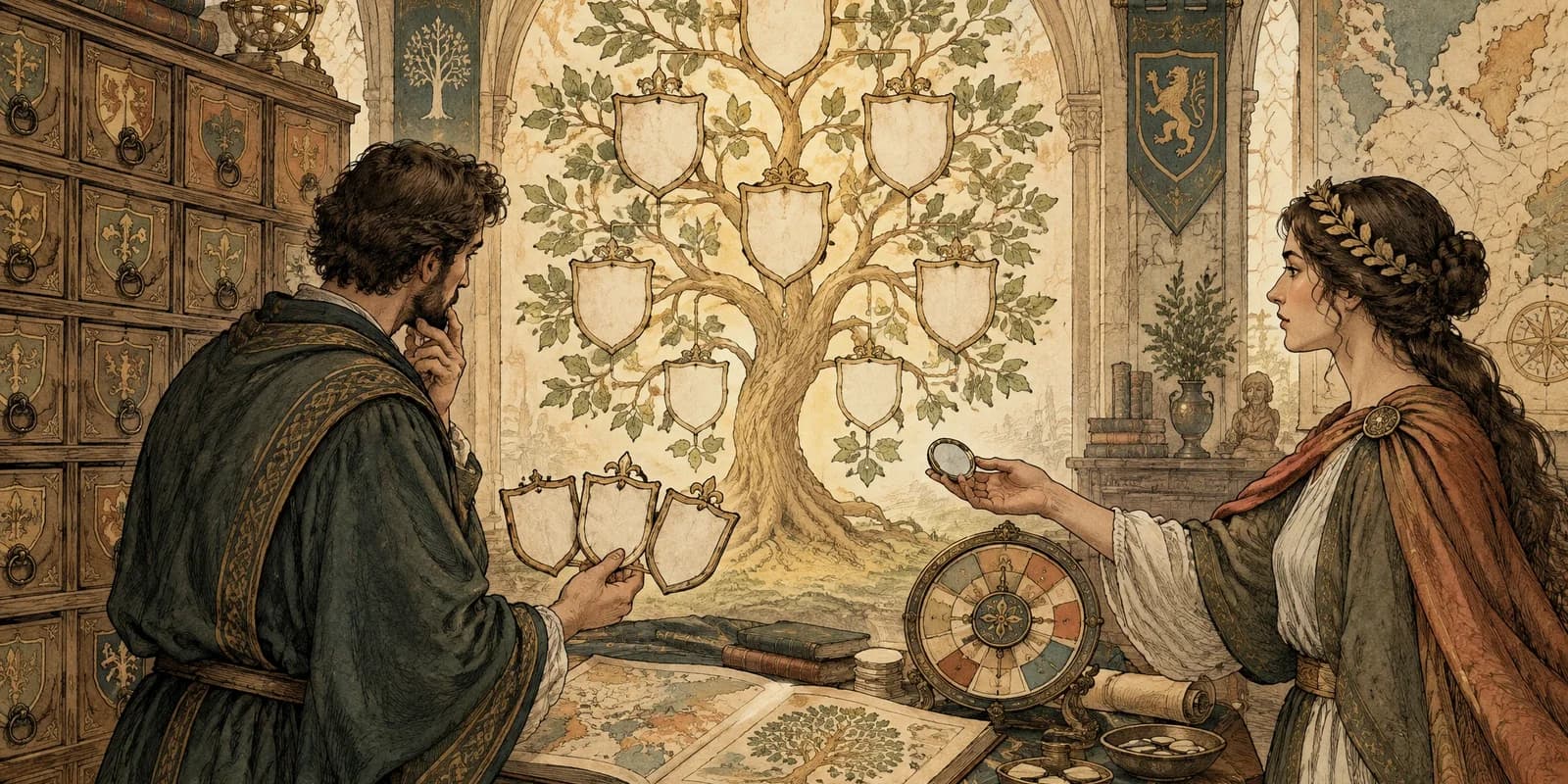
Build a Roman name around era, family, and social context.
A Roman name generator is more useful when it does not treat every ancient identity as the same three-part formula. This tool lets you choose an era, profile, cultural direction, social role, and name structure, then explains the praenomen, nomen, cognomen, historical limits, pronunciation, and story potential behind each result.
How to use the Roman name generator
Start with What are you naming? Choose a full Roman name, a praenomen-style personal name, a family or gens name, a cognomen, a historical-fiction character, or a Roman-inspired fantasy identity. Then choose Profile, Era or direction, Cultural direction, and Social role or status. These choices matter because a Republican citizen, Late Roman scholar, provincial soldier, and fantasy senator should not receive interchangeable structures.
Select qualities such as Classical, Readable, Noble, Military, Scholarly, Elegant, Old, or Fantasy. Open Options for a specific Roman name structure, a name to transform, meaning themes, opening letters, excluded sounds, and How many names? The three editable presets cover a Republican citizen, Late Roman scholar, and Roman fantasy hero.
The page requests exactly the selected number of structured results. It rejects incomplete lists and results that ignore the target, era, cultural direction, social role, structure, profile, or opening letters. Your form choices remain available when a request needs another attempt.
Roman name generator for male and female characters
Use Profile to make the page a Roman name generator for male characters, a female Roman name generator, or a gender-neutral creative naming tool. Profile is only one part of the brief. Era, legal and social status, family context, and the kind of surviving record can matter just as much.
Roman women's names cannot be reduced to “the male name with a different ending.” Recorded practice changed across time and social context, and many women were identified through family connections or feminine forms of a family name. Choose Female family-form direction under Roman name structure when that is the creative direction you want. Each result's Roman naming structure and Historical caution notes explain where the output simplifies a complicated historical record.
For a standalone family name or cognomen, profile may be marked Not applicable because the requested element is not a complete personal identity.
Old, Republican, Imperial, and Late Roman names
The era control answers several different “old Roman name generator” needs instead of collapsing them into one ancient list:
- Roman Republic supports earlier civic and family structures.
- Early Roman Empire and High Roman Empire suit imperial-period characters without treating centuries of change as one moment.
- Late Roman Empire allows later naming patterns and Christian-era or provincial context without automatically copying saints or emperors.
- Eastern Roman / Byzantine transition supports a late-antique eastern direction while remaining separate from a fully medieval Byzantine tool.
These are historically inspired editorial directions, not a live inscription or prosopography lookup. A result can be plausible for fiction without being an attested person from a precise decade. For a wider European period workflow, compare the Medieval Name Generator.
Greco-Roman, Greek Roman, Latin Roman, and Eastern Roman names
Google suggestions such as Greco Roman name generator, Greek Roman name generator, Latin Roman name generator, and Eastern Roman name generator describe related but distinct needs. Use Cultural direction to separate them:
- Latin Roman prioritizes a Latin civic and family texture.
- Greco-Roman supports a bilingual or culturally mixed eastern-Mediterranean setting.
- Eastern Roman suits late-antique eastern imperial characters.
- Romano-British and Roman provincial help when Rome is not the character's only cultural context.
The selected direction appears in every accepted result and is discussed in the social and era notes. For Greek-first naming with Greek script and transliteration, use the Greek Name Generator. This Roman page keeps Roman structure central.
Praenomen, nomen, cognomen, and tria nomina
The familiar tria nomina model combines a praenomen, nomen, and cognomen. It is useful, but it is not a universal template for every Roman person, woman, class, province, or century. Under Options you can choose:
- Single personal name
- Praenomen + nomen
- Tria nomina
- Female family-form direction
- Late or Eastern Roman personal name
- Best fit for era and profile
The details dialog separates praenomen, nomen, cognomen, and agnomen or title. It also explains whether the chosen structure is a historical inspiration, a simplified editorial model, or a Roman-inspired fantasy construction. This makes the tool useful as a Roman surname generator or Roman cognomen generator without pretending that modern first-name and last-name categories map perfectly onto antiquity.
Roman name generator based on your name
The Your name or source name field supports searches such as Roman name generator based on name, Roman name generator from your name, based on my name, and “my Roman name generator.” Choose how the connection should work:
- Similar sound
- Same initial
- Latinized form
- Meaning or theme
- Loose transformation
Every result includes a Source name connection note. A Latinized form is a creative adaptation, not an official translation, proof of Roman ancestry, or a historically attested equivalent. Enter only the small name fragment you want to use as inspiration.
Roman names with meaning
Choose Courage, Victory, Wisdom, Honor, Fortune, Light, War, Peace, Nature, or Rome and civic duty under Meaning or theme. The generator uses the theme to shape associations and character direction. It does not claim that every generated syllable has a documented literal Latin meaning.
Open a result and inspect the meaning note alongside the construction note. A useful explanation should distinguish a familiar Latin association from an invented but Roman-shaped form. Verify exact etymology in a specialist Latin dictionary before presenting it as fact.
Roman fantasy names without copying history
For a Roman name generator fantasy request, choose Fantasy Roman-inspired name, Roman-inspired fantasy as the era or cultural direction, and a social role such as Fantasy character, soldier, scholar, or official. The output may use stronger imagery and more flexible titles while keeping Roman name parts visible.
Fantasy mode does not copy an emperor, legion, game faction, film character, or published setting. It also does not make the result historically authentic. For a broader campaign name shaped by ancestry and class, the DnD Name Generator handles additional tabletop targets.
How to judge a generated Roman name
Open each card before deciding. The details dialog shows the complete form, pronunciation, selected era and role, separated name parts, source connection, naming-system explanation, historical caution, character hook, variants, and four heuristic scores.
Use four checks:
- Structure: Does the result follow the requested one-, two-, three-, female-family, or late-Roman form?
- Era: Does the explanation fit the Republic, Empire, late antiquity, or fantasy direction rather than merely sounding Latin?
- Social context: Does the name suit a citizen, freedperson, soldier, official, provincial elite, or another selected role?
- Verification: Can you distinguish historically attested elements from creative construction?
The scores compare results within the current request. They are not measurements of historical authenticity, social rank, popularity, ancestry, uniqueness, or legal clearance. Save candidates with the heart button, copy one or the visible list, hear the classical form through browser speech synthesis, or use the name wheel when several options remain.
What this tool can and cannot verify
This is an AI-assisted naming and historical-fiction ideation tool. It does not query inscriptions, civil records, genealogy databases, the Roman Prosopography, official Latin dictionaries, or trademark systems. It cannot confirm that a complete generated person existed, that one pronunciation is universally correct, or that a name was appropriate to every province and period.
For serious historical work, verify individual elements in epigraphic, linguistic, and prosopographical references and ask a specialist to review the full context. For fiction, games, or public projects, also search the complete name and close variants for historical figures, existing characters, brands, domains, and platform conflicts.
Common questions
Can it generate ancient Roman male and female names?
Yes. Choose Male or Female, then select the relevant era and structure. The page explains where the result follows or simplifies recorded Roman naming practice.
Can it create a tria nomina name?
Yes. Select Tria nomina under Options. The result separates the praenomen, nomen, and cognomen so you can inspect each part.
Can it turn my current name into a Roman name?
Yes, as a creative transformation. Enter a source name and choose a sound, initial, Latinized, meaning, or loose connection. It is not an official translation or ancestry result.
Does it generate Late or Eastern Roman names?
Yes. Select Late Roman Empire or Eastern Roman / Byzantine transition and pair it with the matching cultural direction and structure.
Are the results historically guaranteed?
No. The output includes historical cautions and verification advice, but specialist sources are still required for claims about attestation, exact era, meaning, status, or pronunciation.